The Gulf Is Building the AI. Its Companies Are Not Yet Readable By It.
No region is spending on artificial intelligence at the rate the Gulf is. So we asked a narrower question than the usual one: not what the Gulf is building for AI, but what AI can currently see when it looks back at Gulf companies. Through our own crawling and analysis we scored every company we hold across the six GCC states on how readable each one is to an AI answer engine, on the same 0 to 10 scale we apply everywhere else.
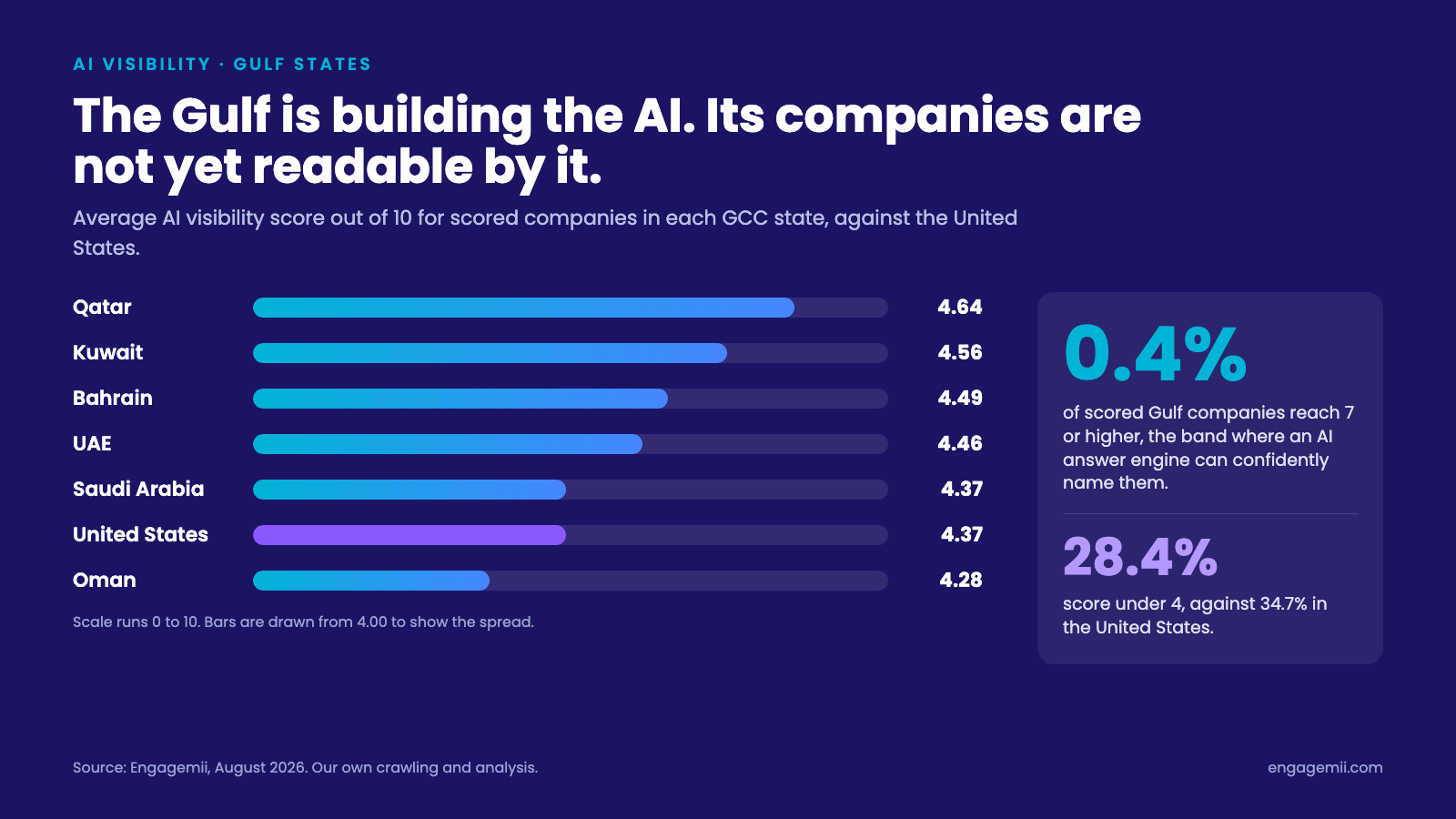
Average AI visibility score out of 10, by country. Source: Engagemii, August 2026.
The region is not behind. It is missing a top.
The first result was not the one we expected. Gulf companies average 4.46 out of 10, against 4.37 for the United States. The weak end is thinner too: 28.4 percent of scored Gulf companies fall under 4, against 34.7 percent in the US. On both of those measures the Gulf is ahead.
Then the top disappears. 0.4 percent of scored Gulf companies reach 7 or higher, the band where an answer engine can state facts about a business with confidence. In the United States it is 0.6 percent. Both numbers are small. One of them is a third smaller.
That shape matters more than the averages. A region where most companies are mediocre and a few are excellent produces AI answers that name the excellent ones. A region where almost everyone clusters in the middle produces AI answers that name whoever the model already knew, which usually means a company headquartered somewhere else.
Qatar and Kuwait lead, and they lead on the measure that counts
Ranked by the share of companies reaching 7 or higher, Qatar comes first at 1.0 percent, then Kuwait at 0.8 percent, Saudi Arabia at 0.5 percent and the UAE at 0.4 percent. Bahrain and Oman have no scored companies in that band at all.
The averages sort the same way at the top: Qatar 4.64, Kuwait 4.56, Bahrain 4.49, UAE 4.46, Saudi Arabia 4.37, Oman 4.28. The spread from best to worst is 0.36 points, which is narrow. The spread in the share reaching the top band is a factor of two and a half between Qatar and the UAE, which is not narrow at all.
The two largest markets in the region, by the number of companies we hold, are the two that convert the least of their base into top-band visibility.
What is actually being measured
A score is not a judgement of the business or the website design. It measures how much a company states about itself in a form a machine can read without guessing: an organization name and identity published as structured data rather than implied by a logo, headings that describe the business rather than decorate the page, real text answering the questions customers ask, a site an engine can reach and parse, and independent corroboration of those facts elsewhere on the web.
That last part is where a lot of Gulf companies lose ground. A great deal of what is known about a regional business lives in press releases, government registries and PDF annual reports. All of that is real, and very little of it is in a form an answer engine will pick up and repeat.
Why this is a window rather than a problem
The gap between the two ends of the score is made of work that nobody in the region has finished doing. It is not a budget problem and it is not a rebuild. When 99.6 percent of companies in a market sit below the confident band, the first ones to publish their facts properly do not have to be better than the global leaders in their category. They only have to be legible when a model is asked about the market they are in.
That window is open right now, and it closes the same way it closed in search: quietly, and in favour of whoever moved while it was still cheap.
The honest limits
These figures cover the companies we hold with a confirmed country in each state: 27,863 in the UAE, 2,386 in Saudi Arabia, 314 in Qatar, 255 in Kuwait, 240 in Oman and 163 in Bahrain, for 31,221 in total. The UAE and Saudi figures are stable at those volumes. Qatar, Kuwait, Oman and Bahrain rest on a few hundred companies each, so treat their percentages as an indication and not a settled fact, and note that a zero in the top band across 163 or 240 companies is a small sample rather than proof that no such company exists. The comparison figures for the United States come from the 15,167,347 US companies we have scored.
Country is taken from what each company publishes about itself, so companies that never state a location are not counted anywhere. This is a measure of how readable a company is to AI, not a measure of how large, how profitable or how good it is.
See where you stand
Your score shows how your own site reads to the machines, on the same scale as every other company in your category and your market. Check yours free at engagemii.com/aeo, or if you want the underlying data for a market rather than a single company, that is at engagemii.com/aeo/data.
If you want to cite this article, the URL is engagemii.com/blog/the-gulf-is-building-the-ai-its-companies-are-not-yet-readable-by-it.
Ready to find out if AI can cite your brand?
Get Your Free AEO Score