AI Recommends the Same Few Brands in Every Category. We Scored 12.8 Million Websites to Find Out Why.
Ask an AI assistant to recommend a protein powder, a CRM, a med spa, an accountant. Now ask it again tomorrow, and next week. The names barely change. Behind every one of those answers, a model quietly runs the same evaluation, and a tiny group of brands keeps passing it while everyone else stays invisible. Nobody handed out the grading rubric. So we went and measured it.
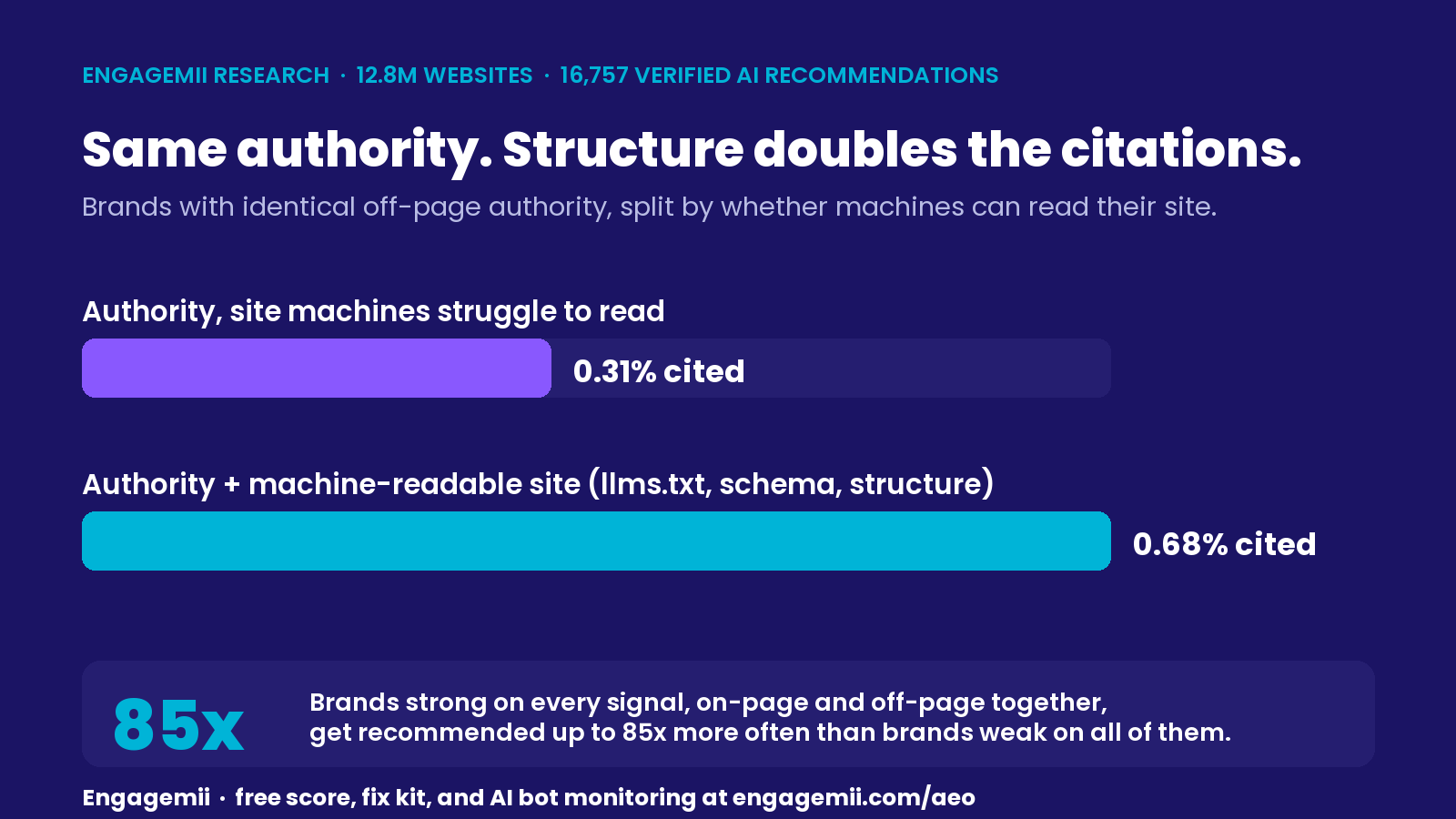
Same authority, double the citations when the site is machine-readable. Source: Engagemii research, July 2026, 12.8M scored websites.
How we got this data
This took months and a scoring fleet that never sleeps. First, we crawled and scored 12.8 million US business websites, grading each one across six on-page categories that together measure a single thing: can an AI actually read this site and confidently repeat what it says? Second, we built an off-page authority score for every brand by mapping public, web-scale evidence: billions of hyperlinks, news archives, community discussion, Reddit conversation, and knowledge-graph records. Third, the ground truth: we asked an AI assistant for recommendations across roughly 380 business categories, the way a real customer would, and logged 16,757 verified moments where it named a specific brand. Then we cross-referenced everything against everything.
The exact formulas stay in the vault, that is our secret sauce. But what the data showed is too useful to sit in a drawer.
Finding one: the shortlist is tiny, and that is your opening
Why do the same names keep winning? Because in most categories, the model barely has a choice. Across 12.8 million sites, the average machine-readability score is 4.53 out of 10, and only about 3 percent of business websites are genuinely AI-ready. Picture a category with five thousand competitors where an AI can cleanly read and confidently vouch for maybe a hundred of them. It recommends from that hundred. Every single time.
The shortlist in your category is almost certainly not full. That is the opportunity, and it will not stay open forever.
Finding two: winners play both sides of the board
Every brand we measured has seven scores: one for how readable its site is to machines, built from six categories of on-page signals, and six more covering its authority across the wider web. When we lined all of them up against the 16,757 verified recommendations, the pattern was unmistakable. Brands strong across the board get recommended up to 85 times more often than brands weak across the board. Not because of one magic signal. Because the signals feed each other: the wider web convinces the model you are real, and your site hands it the words, facts, and confidence to actually recommend you.
Finding three: structure is the multiplier you control today
Here is the cleanest experiment in the whole dataset. Take brands with identical off-page authority, the same footprint across the wider web, and split them by one thing: whether machines can read their site. The readable group gets recommended at double the rate, 0.68 percent versus 0.31 percent. Same reputation. Same links. Same coverage. Twice the recommendations, purely from how the site is built.
Every ounce of authority you have ever earned is converting at half rate if machines cannot read your site. Structure is not optional. It is the multiplier on everything else you have built.
And inside those on-page signals, they are not all equal. Our decomposition found the content-structure work, and one file in particular, llms.txt, a plain-language summary that AI crawlers read first, sitting at the top of the impact ranking on most sites. Almost nobody has one. It takes minutes to install.
This half of the game is mechanical. There are exact right answers, which is why we generate them for you: your llms.txt, your schema, your full fix kit, built from your actual site, ranked by measured impact, free. Installed today, working tonight. This is the half we can simply hand you.
Finding four: the other half you have to earn, and nobody should pretend otherwise
Off-page authority is the half no vendor can install. Among brands AI actually recommended: 88 percent had news coverage, 80 percent showed up in tech and community discussion, 73 percent had a knowledge-graph entry, and over half were part of Reddit conversations. In the general population, each of those signals lives in the low single digits. A brand with real Reddit presence is roughly 15 times more likely to be recommended than average.
Anyone promising to get you cited by AI is selling you something the data says cannot be bought. Coverage, community, reputation: you earn those. What has been impossible until now is knowing WHICH one to earn first.
This is where the seven scores change the game. Blind effort is wasted effort: one brand is two Reddit threads away from moving its authority score, while its neighbor already owns Reddit and needs a news mention or a knowledge-graph entry instead. Same category, opposite next moves. We measure all seven scores for every brand, so instead of guessing, you see your weakest signal and your biggest bang for the buck, ranked.
The tell you can watch live
One more discovery, and it is the most practical one. AI crawlers like GPTBot, ClaudeBot, and PerplexityBot visit business websites constantly, but they do not run JavaScript, so Google Analytics has never seen a single one of them. Our crawl telemetry shows something remarkable: a single visit means little, but the brands those crawlers keep coming back to are about 7 times more likely to end up recommended. Repeat crawls are the model showing interest. It is the closest thing to a live leading indicator of AI recommendation that exists anywhere.
We made that visible too, free: install monitoring and watch which AI crawlers hit your site, how often, and whether they return. The first time you see GPTBot come back three days in a row, this whole subject stops being theoretical.
The playbook
One: get your seven scores. Free, minutes, both sides of the board. Two: install the fix kit, because structure is the multiplier and it is the half that is simply handed to you. Three: point your real-world effort at your highest-payoff gap, the one the data ranks for you, and watch your authority score and your crawler activity respond. That loop, fix, earn, measure, repeat, is exactly what the 85x brands are running. Almost none of your competitors have even started.
The fine print we volunteer: this is correlation at massive scale, not a lab experiment, and famous brands amplify every number. But the doubling held at equal authority across the entire dataset, the signal gaps are enormous, and we re-measure recommendations on a schedule to watch brands move as their scores improve. This is also the first article in a series: we will go deeper on each signal, what moves it, and what it is worth.
Start with your seven scores, your fix kit, and your bot monitoring, free, at engagemii.com/aeo. The shortlist in your category has open seats. Take one.
If you want to cite this article, the URL is engagemii.com/blog/how-ai-decides-which-brands-to-recommend-every-signal-together.
Ready to find out if AI can cite your brand?
Get Your Free AEO Score