Republicans vs Democrats: Who Is Winning AI Search? We Scored 1,020 Candidates. Neither.
Every election metric gets compared by party: fundraising, ad spend, ground game. Here is the newest one, measured for the first time: when a voter asks an AI assistant about a race, whose candidates can the AI actually see? We scored 1,020 verified 2026 candidate and governor websites, 466 Republican and 554 Democratic, with the same 0-10 AI visibility scoring we run on 13 million businesses. No party lens. Just measurement.
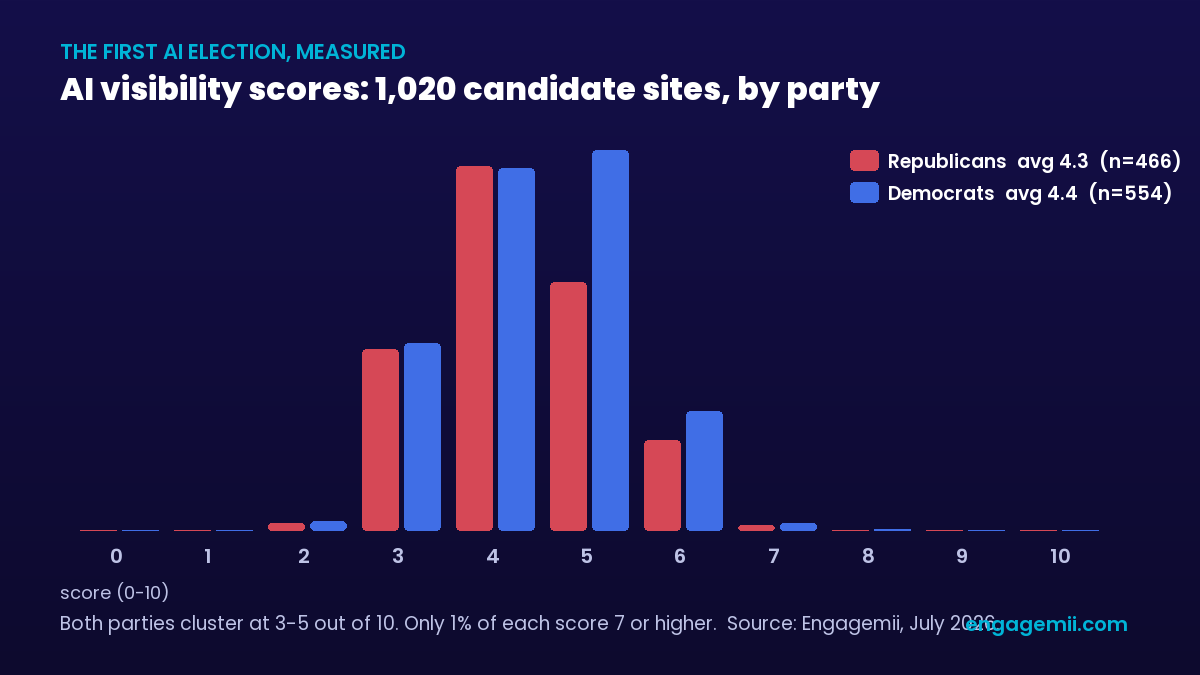
Both parties cluster at 3-5 out of 10. Republicans average 4.3, Democrats 4.4. Source: Engagemii, July 2026.
The headline: it is a tie, and both sides are failing
Democrats average 4.4 out of 10. Republicans average 4.3. That gap is statistical noise. The real story is the ceiling: only about 1 percent of candidates in either party score 7 or higher, the level where a campaign site is genuinely easy for an AI engine to read, quote, and cite. One in five candidates on each side scores 3 or lower, close to invisible.
The best-scoring site in the entire field belongs to a House challenger in New York who scored 8 out of 10, ahead of every incumbent, every senator, and every governor we scored. Down-ballot candidates with clean, machine-readable sites are quietly beating famous names at the exact channel where being readable matters most: races where the AI has no prior knowledge and must rely on what it can fetch.
Why this matters more for challengers than incumbents
AI models already know a great deal about nationally famous politicians. Ask about a top-of-ticket race and the model answers from its training. Ask about a state house race or an open primary, and the model has to lean on what it can read right now: the campaign site, news coverage, whatever structured data exists. That is where a readable site changes what the AI says, and it is exactly where most campaign sites fail.
For a challenger, this is the cheapest earned-media channel that exists: the fixes are files and markup with objectively right answers, installable in an afternoon, and almost no opponent has done them.
What campaigns get wrong
The same failures repeat across both parties: no structured data telling engines who the candidate is and what office they seek; donation-platform templates that bury the candidate's own story; robots rules that accidentally block AI crawlers entirely; and thin, image-heavy pages that read as almost empty to a machine. None of these are ideological problems. They are checklist problems.
The honest limits
A visibility score is not a prediction of who wins, and we are careful not to overclaim. This measures whether an AI engine can find and read a campaign site, nothing about the candidate or their politics. Coverage skews toward candidates with resolvable websites, and famous candidates carry advantages no site fix erases. What the data shows cleanly: the AI-readiness playing field is nearly level between the parties, wide open within them, and almost nobody has moved yet.
See the whole board
Every scored candidate is public, side by side with FEC campaign finance figures, at engagemii.com/aeo/elections. Campaigns can get their site scored free, with the fixes ranked by impact. Voters are already asking AI about your race; the only question is whether it can read your answer.
If you want to cite this article, the URL is engagemii.com/blog/republicans-vs-democrats-ai-search-neither-party-is-winning.
Ready to find out if AI can cite your brand?
Get Your Free AEO Score