Which AI Crawlers Are Actually Reading the Web
Everyone talks about AI reading the web. Almost nobody has measured which AI is doing the reading. We can, so we did.
Here is the setup. Through our own crawling and analysis we score more than 34 million websites worldwide, and we publish a public page for each business we score. AI crawlers come and read those pages. We log every visit. Then we check the source IP address against the list of addresses each AI company publishes for its own crawler, so we know the traffic is really who it says it is. A user agent string can be faked by anyone. An IP inside the operator's own published range cannot.
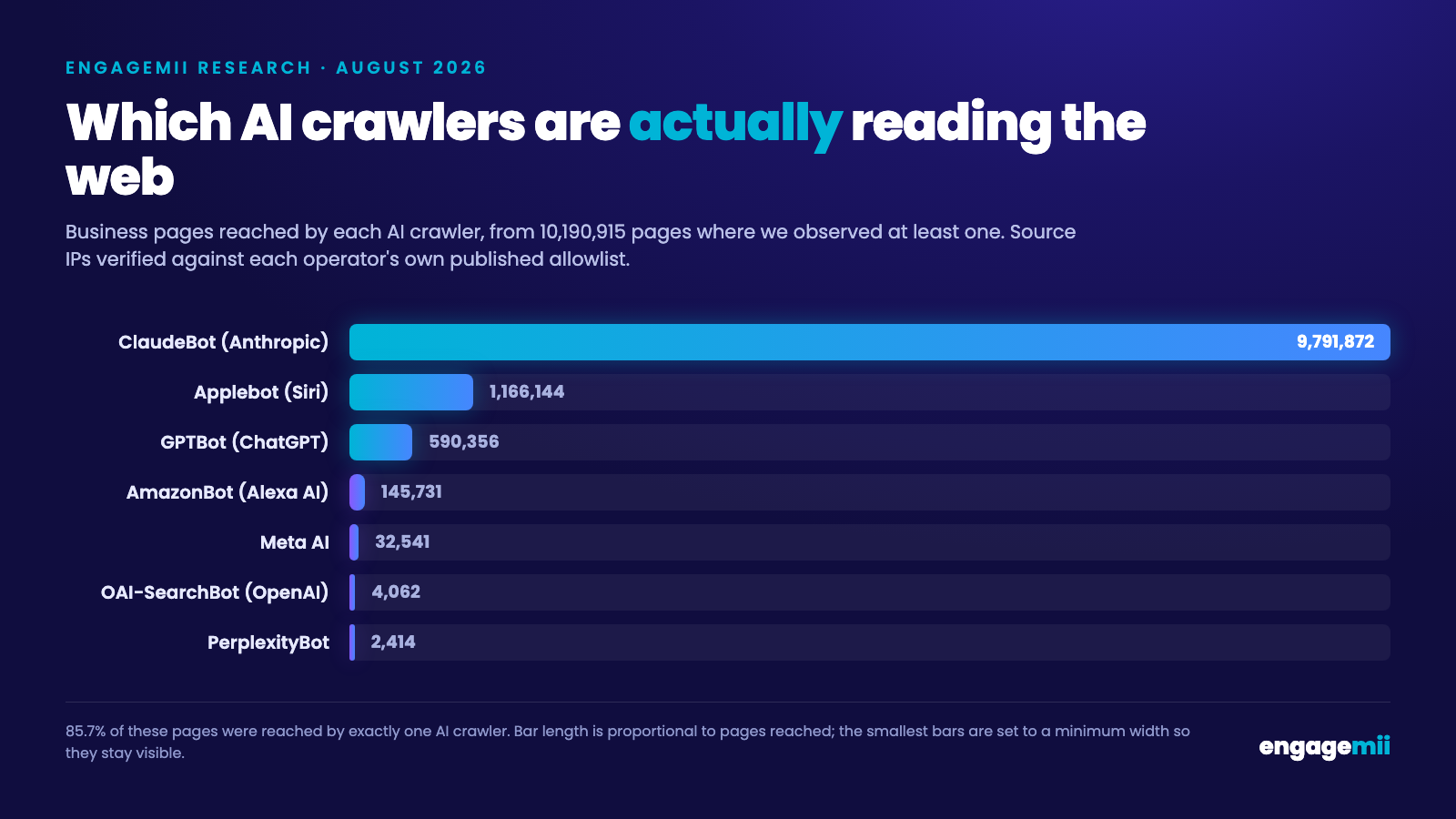
AI crawler reach across 10,190,915 business pages. Source: Engagemii, August 2026.
That gives us something rare: one big shelf of business information, all in the same place, all equally available to every AI company at the same time. Same pages. Same host. Same day. So when one crawler takes far more off that shelf than another, the difference is about the crawler, not about the content.
Across 10,190,915 business pages we recorded at least one AI crawler, and 14,699,697 visits in total. Here is who showed up.
The reach gap is enormous
ClaudeBot reached 9,791,872 pages. Applebot, the crawler behind Siri, reached 1,166,144. GPTBot, the crawler behind ChatGPT, reached 590,356. After that the numbers fall off a cliff: AmazonBot 145,731, Meta AI 32,541, OAI-SearchBot 4,062, PerplexityBot 2,414.
The widest-reaching AI crawler covered eight times more business pages than the second, and sixteen times more than the third.
One more thing stands out at the bottom of that list. Google's AI-labelled crawlers, the ones that identify themselves as gathering material for AI products rather than for classic search, barely register. GoogleOther appeared on 113 pages. That is not a typo, and it is not a statement about Google search, which is a separate system entirely. It is a statement about how little the AI-specific crawlers of some very large companies are currently reading.
Most pages get exactly one visitor
Reach is not the same as depth. Of the 10,190,915 pages with any AI crawler activity, 8,731,104 were reached by exactly one crawler. That is 85.7 percent.
Only 72,220 pages, seven tenths of one percent, were read by three or more different AI engines.
So the common experience for a business is not being read by the AI industry. It is being read by one part of it. If you are on that 85.7 percent, an answer engine that never came to your page is answering questions about your category using somebody else's information.
The pages several crawlers want are the readable ones
This is the finding we did not expect to be so clean. We looked at the average AI visibility score of a page against the number of distinct AI crawlers that read it. Scores run from 0 to 10 and measure how clearly a business explains itself to a machine.
Pages read by one crawler average 4.41. Two crawlers, 4.27. Then it climbs, and it does not stop: three crawlers 4.99, four crawlers 6.02, five crawlers 6.51, six crawlers 6.65.
The jump from one AI crawler to four comes with a jump of more than a point and a half in score, on a scale of 0 to 10.
The same pattern shows up when you isolate a single crawler. Pages that GPTBot read average 5.22. Everything else averages 4.35. GPTBot is reaching a much smaller slice of the web than ClaudeBot, and the slice it reaches is a notably clearer, better-organized one.
We are not claiming that a score causes a crawler to visit, or that a visit raises a score. We are reporting an association we can see across ten million pages: the material several AI engines converge on is material that is easy for a machine to read.
Different crawlers want different industries
Crawlers are not interchangeable, and their appetites are not random. Counting within each category of the 10,190,915 pages above, Applebot shows a strong pull toward local and in-person businesses. It reached 34.3 percent of the automotive pages, 29.0 percent of travel and hospitality, 23.1 percent of healthcare, 22.0 percent of professional services, 21.8 percent of health and wellness, and 21.1 percent of education. At the other end it reached only 6.2 percent of real estate and 6.0 percent of food and beverage.
GPTBot leans a different way. Its strongest categories are travel and hospitality at 9.6 percent, fashion and apparel at 9.3 percent, and pet care at 9.0 percent. Its weakest is real estate at 3.2 percent.
If you sell cars or run a clinic, the assistant most likely to have read about you is not the one you were worried about.
That matters practically. Which AI engine is worth your attention depends on what business you are in. Treating ChatGPT as the whole of AI search is how a car dealer ends up optimizing for the crawler least likely to visit.
What to take from this
Three things. First, AI reading of the web is far more uneven than the headlines suggest, and one company is doing most of it. Second, being read once is normal and being read by several engines is rare, which makes the rare group worth studying. Third, the pages in that rare group have something in common, and it is not size or fame. It is that a machine can understand them without guessing.
None of that requires a big budget. It requires saying plainly what your business is, who runs it, what it offers, and where it operates, in a form a machine can parse. That is the whole job.
The honest limits
This measures crawler behavior on our pages, not on yours, and a crawler visit is not the same thing as a citation in an answer. Crawlers also change their behavior over time, so these shares are a picture of now rather than a permanent ranking. Category labels come from our own classification and are not perfect. And a page read by one crawler today may be read by four next month. We report what we observe.
You can see how machine-readable your own site is, and which AI crawlers have been reading it, with a free AI visibility score at engagemii.com/aeo.
Ready to find out if AI can cite your brand?
Get Your Free AEO Score