Businesses With a Mobile App Get Read 1.4x More by AI Crawlers
We spend our days measuring two things about the AI web: whether the crawlers behind ChatGPT, Claude, Gemini, and the rest actually read a business, and what they can understand when they do. We have logged more than 15 million of these crawler visits and scored tens of millions of sites. So we did the obvious thing and asked the data a blunt question: forget opinions about what AI wants, what actually separates the businesses that get read from the ones that get skipped?
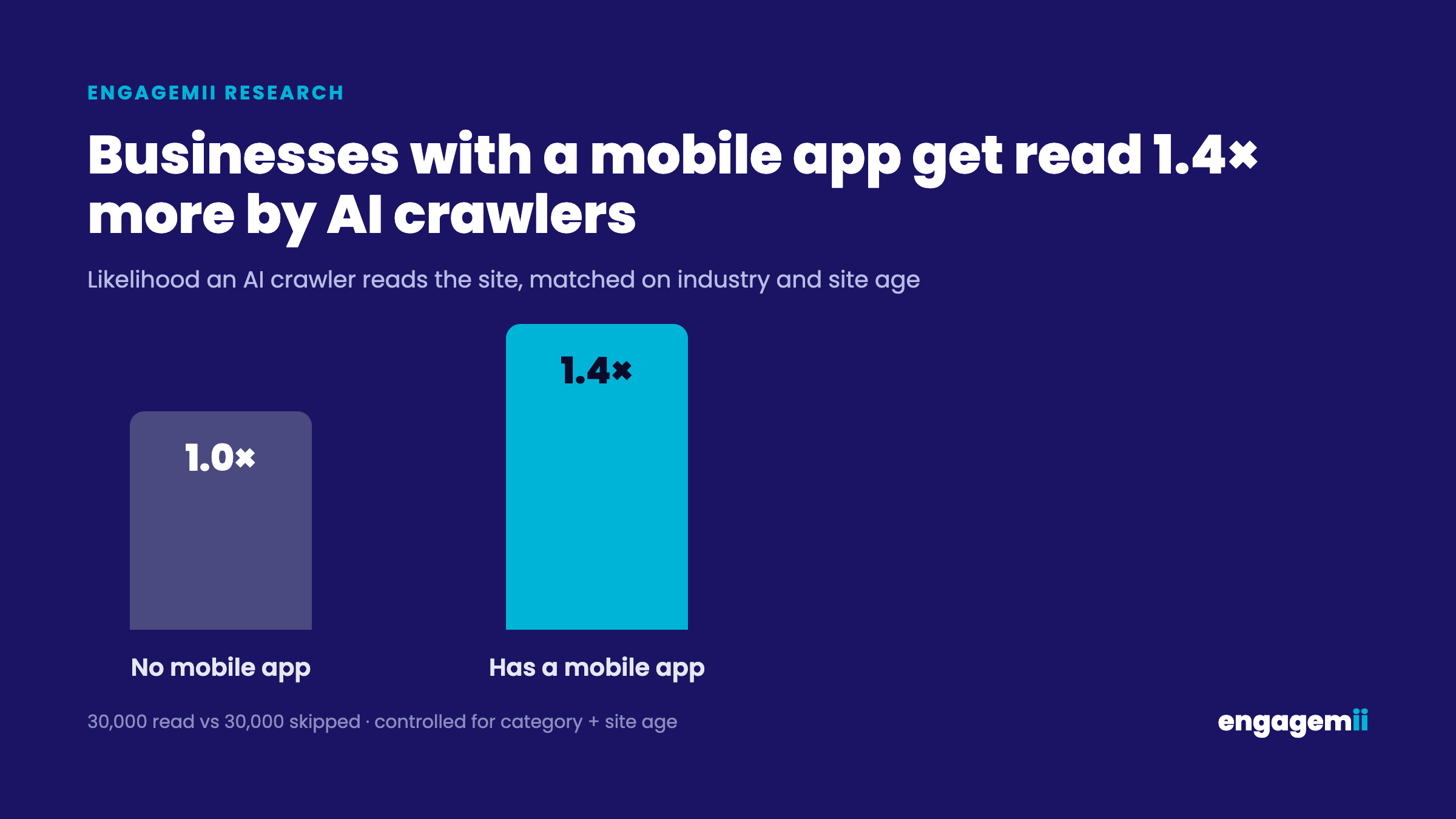
Businesses with a mobile app are 1.4x more likely to be read by AI crawlers, holding industry and site age constant. Source: Engagemii, July 2026.
The finding: a mobile app is one of the strongest signals we tested
We took roughly 30,000 businesses that AI crawlers had read and 30,000 the same crawlers had skipped, and matched them on the two things that obviously confound everything: industry and how old the site is. Then we compared their footprints. Businesses with a mobile app in the App Store or Google Play were about 1.4 times more likely to be in the read group. That is a large effect for a single, off-website signal.
Our first assumption was the boring one: apps are a proxy for bigger, more established companies, and big companies get crawled more anyway. So we checked inside narrow bands of domain authority, comparing app-havers only against non-app businesses with the same off-site link footprint. The signal held. Having an app carried its own weight, independent of company size. That is what makes it interesting rather than obvious.
Why an app would make your website more readable
The likeliest explanation is that a mobile app is not a website feature at all. It is a second, highly structured description of your business sitting in two of the most heavily indexed catalogs on the internet: the App Store and Google Play. Each listing states, in clean machine-readable form, who you are, what you do, what category you belong to, and links back to you. An app quietly plants your identity in places the engines already trust and read constantly.
In other words, the app does not make your homepage better. It makes the rest of your footprint say your name in more places the machines are already looking.
The bigger lesson: AI reads your footprint, not your website
This is the pattern under almost everything we measure. Businesses treat AI visibility as a website problem, something you fix on your homepage. But an AI engine deciding whether to read and trust you is assembling a picture from everywhere your name appears: app stores, business listings, links, mentions, reviews. The website is the center of that picture, not the whole of it. The app finding is just a clean, measurable example of a much larger truth. The engines read the footprint.
The honest limits
This is a correlation from observational data, not a controlled experiment, and we will not pretend otherwise. We cannot promise that shipping an app tomorrow would move your crawl rate, and an app is almost certainly standing in for a bundle of habits that well-run businesses share. What we can say cleanly is that the signal survives the controls that usually explain these things away: it is not just industry, not just site age, and not just company size. Whatever the app is a marker of, the machines are responding to it.
See what the crawlers do with your footprint
You can measure both halves for your own business, free: get an AI visibility score that reads your whole footprint, on-page and off, and turn on monitoring to see which AI crawlers actually visit you and how often. Both at engagemii.com/aeo.
If you want to cite this article, the URL is engagemii.com/blog/businesses-with-a-mobile-app-get-read-more-by-ai-crawlers.
Ready to find out if AI can cite your brand?
Get Your Free AEO Score