We Deep-Read 14 Million Business Websites. Here Is What Most Are Missing.
There is a comfortable version of AI visibility that is mostly a checklist: add schema markup, write a meta description, drop in an llms.txt file, done. We used to grade sites that way too. The problem is that an AI engine does not read your checklist. It reads your page, the actual sentences, and tries to extract three things: who you are, what you offer, and where you are. So we rebuilt our scoring to do the same, reading the content instead of counting the tags, and re-ran it across 14 million business websites. The results were humbling, and clarifying.
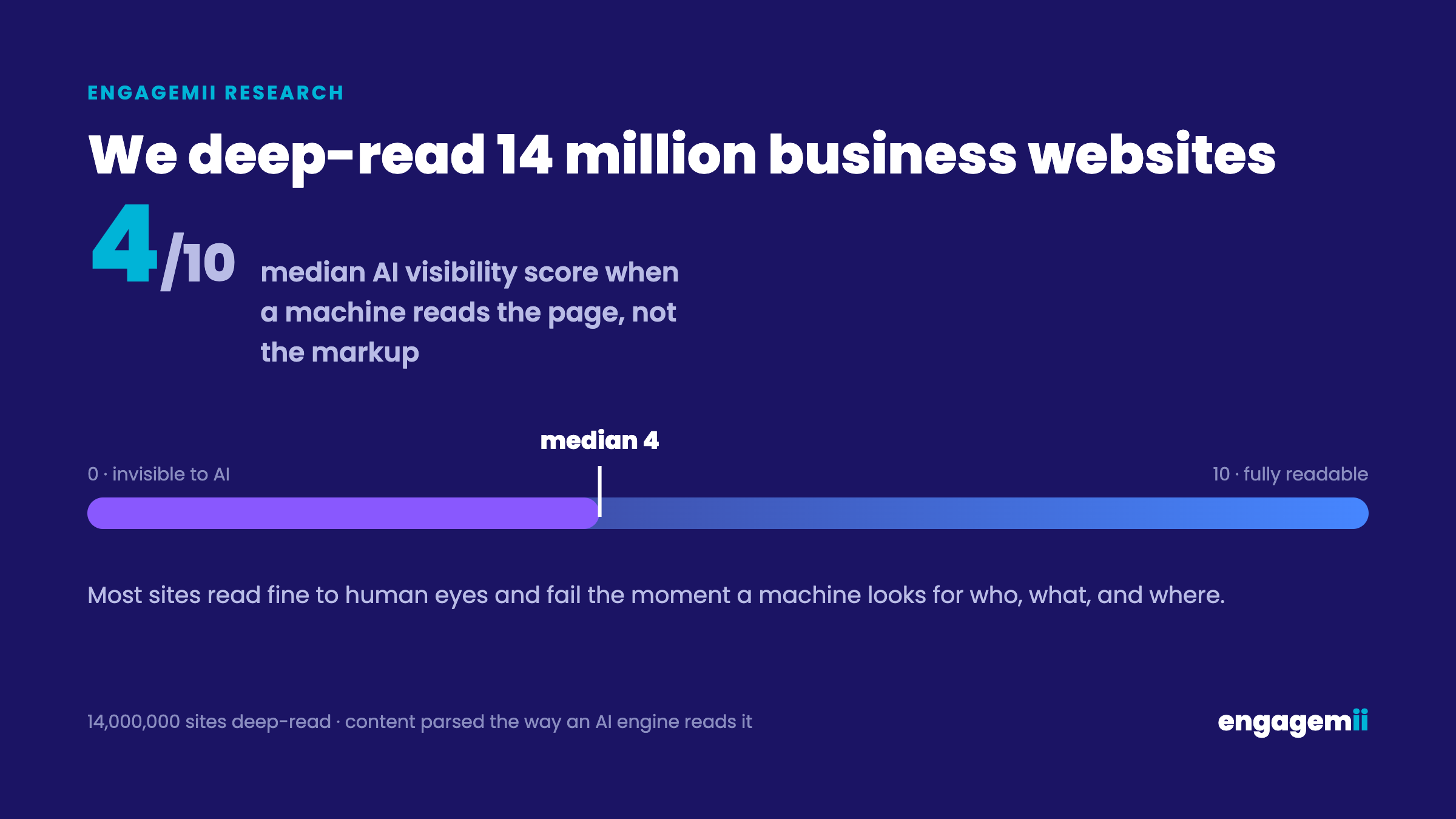
Across 14 million deep-read business sites, the median AI visibility score is 4 out of 10. Most sites are legible to human eyes but hard for a machine to extract. Source: Engagemii, July 2026.
The surprise: most sites are not broken, they are built for human eyes
The failing sites are, overwhelmingly, perfectly nice websites. They load, they look good, a person understands them instantly. The break happens the moment a machine has to extract facts instead of impressions. A hero image with the company name baked into the pixels tells a person everything and a crawler nothing. A beautiful about page that never states, in plain text, what the company actually sells. A contact page with the address rendered inside a map widget the parser cannot read.
When we read pages the way an engine does, the median business site scores 4 out of 10. Not because owners did something wrong, but because the whole web was built for eyes, and the newest reader on it does not have any.
What separates a readable site from an invisible one
The dividing line is almost never design quality or how much was spent. It is whether the three basics survive being read by a machine. Can a crawler pull your business name out of real text, not just a logo? Is there a plain-language sentence, early on, that says what you do? Does a real, parseable address appear somewhere an extractor can find it? Sites that clear those three quietly outscore far flashier competitors, because they answer the exact questions an engine has to answer before it will put you in a response.
Why we stopped counting tags
Counting tags rewards the wrong thing. A site can carry perfect schema markup and still be unreadable if the words on the page never say what the business does; another can have almost no markup and read beautifully because the writing is clear and direct. Markup helps, and we still credit it, but it is the seasoning, not the meal. Reading the actual content is the only way to score the thing the engine is actually doing. That is why we rebuilt it, and why the new scores move for real reasons you can act on.
The honest limits
A visibility score measures whether a machine can read and understand your site. It does not measure whether your business is good, and it does not guarantee an AI will choose to mention you once it can read you, that depends on your whole reputation, not one page. Our coverage skews toward businesses with resolvable websites, and a deep read of a live page is a snapshot in time. What it measures cleanly, and what almost no one else measures at all, is the gap between how a person sees your site and how a machine does.
Find your own gap
Get your site deep-read for free: a 0-10 AI visibility score based on what a machine can actually extract, with the specific fixes ranked by how much they move the number. The reading is done for you; the question is just whether you like what it found. At engagemii.com/aeo.
If you want to cite this article, the URL is engagemii.com/blog/we-deep-read-14-million-business-websites-what-most-are-missing.
Ready to find out if AI can cite your brand?
Get Your Free AEO Score